
What Happened to ACIP? This time?
The Quiet Retreat from a More Radical Rewrite of Federal Vaccine Policy
By - Joe Zamboni, J.D., M.P.H.
Over the last several months, one of the most consequential, and least publicly discussed, developments in vaccine policy has not been a court decision or a congressional hearing. It has been a fight over the governing documents of the federal advisory committee that shapes America’s immunization recommendations.
The Advisory Committee on Immunization Practices (ACIP) is not a household name. But it plays an outsized role in public health. ACIP reviews evidence, evaluates vaccine safety and effectiveness, and makes recommendations that ultimately shape federal immunization schedules, insurance coverage, school policies, and clinical practice.
That is why changes to ACIP’s charter matter. And in 2026, we briefly saw an attempt to redefine what ACIP is, and perhaps what vaccine governance itself should become.
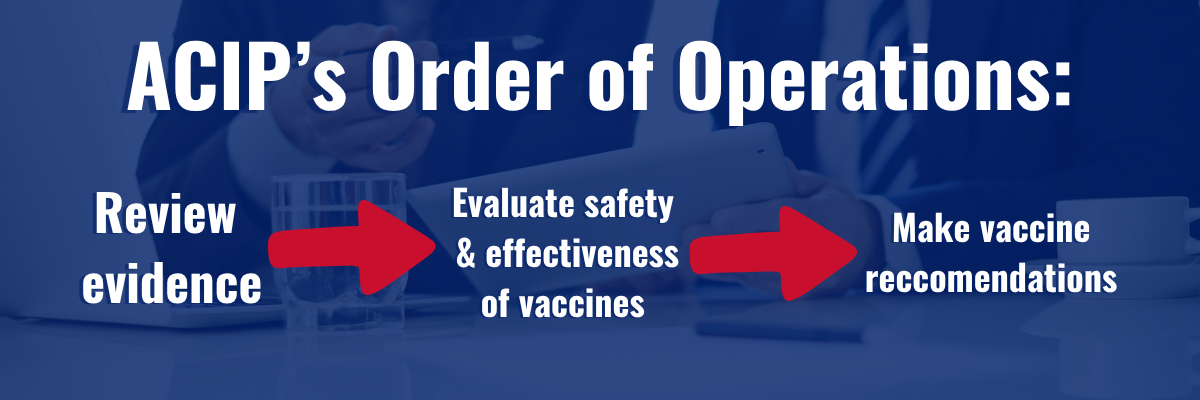
First came the expansion. The traditional 2024 ACIP charter reflected a familiar public health model: review evidence, assess safety and effectiveness, advise CDC leadership, and support disease prevention through evidence-based immunization policy. Then, in April 2026, a new draft charter appeared. The changes were not merely administrative.
The proposed language expanded ACIP’s conceptual role from evaluating evidence to continuously re-examining vaccine risks, individualized immune responses, and unresolved safety questions. It introduced themes such as:
“gaps in vaccine safety research”
“cumulative exposures to vaccines and vaccine components”
re-analysis of vaccine safety and efficacy
variability in immune response
recovery from serious vaccine injuries
For observers of vaccine politics, these phrases felt familiar. The language echoed arguments that have circulated for years within vaccine-skeptical advocacy movements, particularly concerns around cumulative exposure and calls for perpetual re-litigation of established evidence. That shift represented something important: a move away from public health recommendations grounded in population-level evidence and toward a framework emphasizing individualized risk and continuous reassessment.
The mRNA signal was not subtle, either. One of the most striking changes in the April charter was the explicit singling out of “novel vaccine platforms such as mRNA vaccines” for ongoing review. That language is notable because previous ACIP charters did not isolate specific vaccine technologies for heightened scrutiny. Whatever one’s politics, singling out one platform in the committee’s foundational document suggested a shift from technology-neutral scientific review toward issue-specific oversight. That would have represented a meaningful philosophical departure.
Charters are often less revealing for what they say than for who they invite into the room. The April proposal expanded the categories of expertise contemplated for committee membership to include:
toxicology
pediatric neurodevelopment
recovery from serious vaccine injuries
data science and statistical analysis
On paper, these categories may appear unobjectionable. But institutions communicate priorities through structure. Adding pediatric neurodevelopment and vaccine injury expertise while elevating language about individualized harms inevitably raised questions about whether ACIP’s mission was being repositioned from recommendation-making to skepticism-centered review. The liaison changes amplified those concerns. The April draft reportedly retained traditional medical organizations while adding groups frequently associated with more vaccine-critical perspectives, and notably omitted long-standing maternal health representation.
Then… it disappeared. By May 2026, the administration issued a much narrower re-establishment notice. And almost all of those expansions were gone. The new document returned to conventional language focused on:
statutory authority
procedural legitimacy
scientific expertise
implementation
institutional continuity
The cumulative exposure language disappeared. The references to mRNA disappeared. The expanded stakeholder categories disappeared. The liaison list disappeared entirely. From one perspective, this looked like a retreat. From another, it looked like litigation management.
The timing matters. ACIP’s procedural legitimacy had become increasingly important amid active legal challenges and broader scrutiny of federal vaccine governance. Re-establishing a defensible charter may simply have become more urgent than pursuing broader policy ambitions.
The real question isn’t what changed. It’s what didn’t. It would be easy to interpret the May notice as evidence that nothing meaningful happened. I do not think that is the right lesson. Institutional documents often reveal policy aspirations before implementation catches up. The April charter may no longer be operative. But it provided an unusually transparent glimpse into a competing vision of vaccine governance, one less centered on population health and more centered on individualized risk, expanded skepticism, and restructured expertise.
The May retreat may have restored ACIP’s procedural footing. But it did not necessarily resolve the broader debate about what federal vaccine policy institutions are being asked to become. And that debate is likely far from over.